Hindu matrimony in New Zealand
Hinduism is the largest religion among Indian New Zealanders and the fastest growing in the country. A Hindu rishta here can be North or South Indian, Gujarati or Fiji Indian, Sanatan or Arya Samaj, and the site has to cope with all of that without pretending to be a pandit. This page is about how it does.
Open in New Zealand today. Every profile is ID-checked before anyone can see it. Page updated .
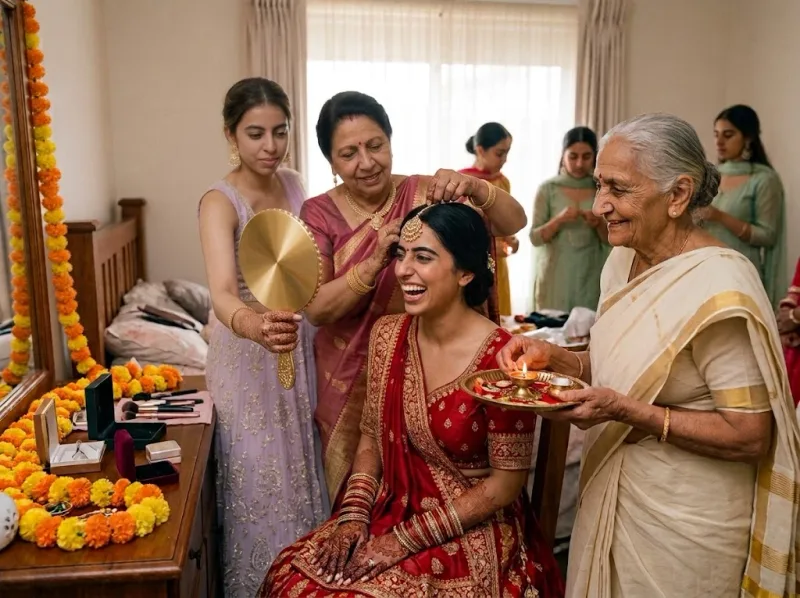
The largest religion in the community
| Census | Hindus in New Zealand |
|---|---|
| 2013 | 90,018 |
| 2018 | 123,534 |
| 2023 | 153,534 |
That is 2.9% of the country, and among Indian New Zealanders Hinduism is by some way the largest religion, nearly half the community at the last census that asked the question in detail. It is also the broadest word on this site. A Hindu family in New Zealand may be from Gujarat, Punjab, Uttar Pradesh, Tamil Nadu, Kerala or Andhra, or from Fiji by way of all of those, and may be Sanatan, Arya Samaj, Swaminarayan or Vaishnava.
The temples
The Bhartiya Mandir on Balmoral Road in Auckland is the oldest and the largest Hindu temple in New Zealand. Around it the city has mandirs in Henderson, Māngere (the Tamil community’s Thiru Subramaniyar Aalayam), Ōtāhuhu, Papakura, Eden Terrace, Papatoetoe and Avondale, where the BAPS Swaminarayan mandir is.
Hamilton has the Sri Balaji Temple, opened in 2015, and a BAPS mandir in Pukete. Wellington has the Kurinchi Kumaran Temple in Newlands, a North Indian style temple run by the Wellington Indian Association, the Sri Venkateswara Swamy Temple in Wainuiomata and a BAPS mandir in Taita. Christchurch has the BAPS mandir in Papanui, the only Hindu temple in the South Island. Tauranga and Rotorua have temples of their own.
The Auckland Diwali Festival in Aotea Square has been the city’s largest public Indian event for over twenty years, and for a lot of families it is where a quiet word about a son or daughter first gets passed along.
What a profile here asks, and what it leaves to you
The India-built sites try to be the pandit: horoscope matching, manglik flags, nakshatra, gotra. Most of it is guesswork at scale and most families here do it properly themselves once two profiles are talking. Rishta does not pretend. What it does is put the questions families filter on first onto the profile, so that the people you see already fit:
- Religion and community, as separate fields, with no preference always available.
- Sanatan or Arya Samaj, listed separately.
- Mother tongue: Hindi, Gujarati, Punjabi, Tamil, Telugu, Malayalam, Marathi, Fiji Hindi and the rest.
- Diet, a field and a filter.
- Family origin: India, New Zealand, Australia or elsewhere, with the native place in your own words.
- Residency status, and whether someone is open to living in the other country.
Any of those can be a must-have. Horoscopes, gotras and the rest are for the About section, in your own words, and for the families to settle between themselves.
Why women here are not on the big sites
The Hindu community in New Zealand is large enough to have temples in every city and small enough that a photo on a public gallery is recognised within the week. Our founder, logged in as a paying member of the largest matrimonial site on 19 September 2026, saw it print a count of 8 women in all of New Zealand for one ordinary search. The women are here. They have decided a public gallery, a contact-details paywall and a feed of bulk interests are not for them.
So there is no gallery on Rishta. Photos are private until she approves one particular person, and shown both ways once an interest is accepted. She decides whether every approved man can find her, only the men who match her preferences, or nobody except her matchmaker. Every interest carries a personal message. Contact details are never on the page. And every profile has passed an ID check and been read by a person before anyone can see it.
From a match to the mandap
Families can be involved from the start: a parent can make and manage the profile, relatives who are not members can be shown a Family View page, and a matchmaker can speak to the family with the member’s consent. When the families agree, registering a marriage in New Zealand explains the licence, the three days’ notice, and how a temple ceremony becomes the legal marriage. If the match is in India, the culturally arranged marriage visa is the route Immigration New Zealand built for it.
Hindu families who are Gujarati, Tamil or Fiji Indian have pages of their own: Gujarati, Tamil, Fiji Indian. And a search can cover Australia as well, in one go. Joining is free until 31 December 2026 for everyone who joins now.
Questions before you join
Do you match horoscopes?
Can I search for vegetarian, or for a particular mother tongue?
We are Arya Samaj. Does the profile say so?
Can a Hindu family search for a particular community?
Will the temple wedding be legal?
What does it cost?
Also in New Zealand
- Indian matrimony in New Zealand
- Punjabi matrimony in New Zealand
- Sikh matrimony in New Zealand
- Gujarati matrimony in New Zealand
- Tamil matrimony in New Zealand
- Telugu matrimony in New Zealand
- Malayali matrimony in New Zealand
- Muslim matrimony in New Zealand
- Indian Christian matrimony in New Zealand
- Fiji Indian matrimony in New Zealand
Join Rishta in New Zealand
Join now and it’s free until 31 December 2026. After that, Search is $39 a month or $99 for 3 months, the same for women and men.